Friday, September 21, 2012

Photos of a Placenta Encapsulation Day 2

This is day two of the placenta encapsulation photos. If you missed day one, you can visit that post here. This is not a tutorial, but my goal is to help normalize this process by providing a means for people to see it. 


 This is what the placenta looks like after dehydrating.

This is the dried umbilical heart keepsake. It usually turns out quite cute, but it helps to have a long cord. If you're able to ask for the cord to be cut further away from the placenta, it makes the heart shape turn out cuter.


The stripes get ground up into a fine powder.

Imagine that's all that is left of the placenta. It reduces quite a bit, but the amount of powder you see here will yield about 130 capsules.


I use a capsule filler machine, and I try to make sure I get every possible speck of the placenta powder into the capsules. You can see I have a little helper with me in the picture. I do Not bring my children to an encapsulation with me, but this was for a friend with a daughter the same age as mine. Ideally, the encapsulation process should be performed in your home.


Finished product. No this wasn't the full amount of capsules shown here. Day two is always a little more rewarding for me because the capsules get finished and I feel accomplished.


Thursday, September 20, 2012

Photos of a Placenta Encapsulation Day 1

Here are some photos from a recent placenta encapsulation. I think it's great for people to see the process as it helps to normalize it. This is not, however, a tutorial. If you are trying to do the encapsulation yourself from these pictures, you will miss critical steps. If you're interested in learning how to do a placenta encapsulation yourself, I recommend the only training program in the world at www.placentabenefits.info.

So here is the placenta in the biohazard container the hospital puts it in.


Here is the amniotic sac.


This is the fetal side of the placenta, so it faces the baby. I'm always a little sad to see how pump the veins are in the placenta like this. There's a lot of blood left, which means the baby didn't get the blood that was in the cord, which deprives the baby of up to a third of its blood. This baby was born via C section, and early cord clamping happens more frequently in a C section.

This is the maternal side of the placenta, the part that was attached to the uterus.

The placenta is ready for steaming.

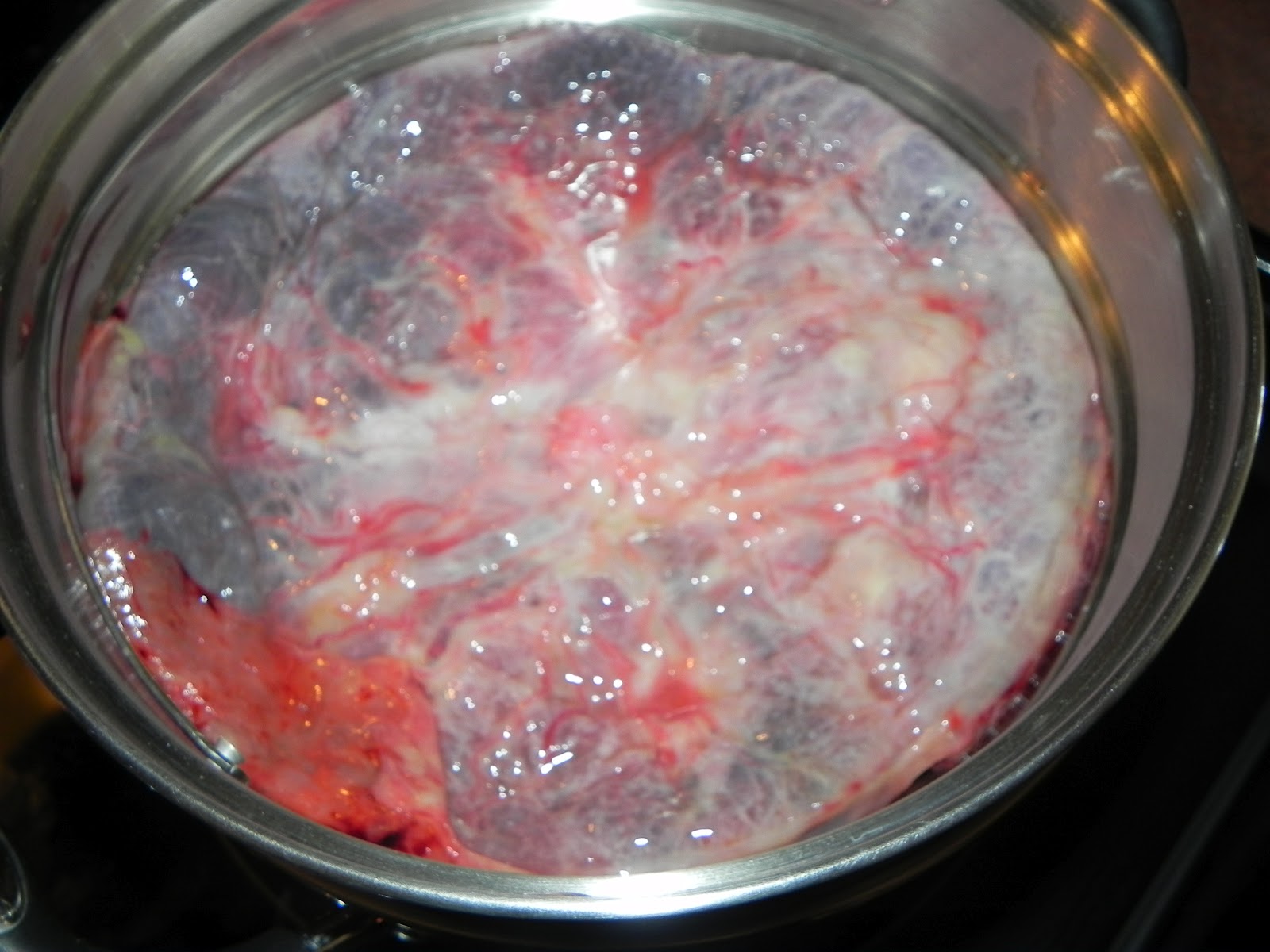
Here it is being steamed.


 It browns just like meat.

That's what it should look like folks.


A memento.

This is the placenta completely steamed. It shrinks up quite a bit.

Ready for slicing.


This is the placenta completely sliced.

Here is the placenta on the dehydrator sheets.


 All ready for it's time in the dehydrator. Stay turned for Day 2 pictures of the process tomorrow!

Wednesday, September 19, 2012

Placentas Discovered to Produce Serotonin

Researchers have discovered yet another fascinating fact about what an incredible organ the placenta is. For the past 60 years, researchers have theorized that the maternal blood supply is responsible for supplying the fetus with serotonin. It has now been discovered that the placenta actually synthesizes or produces serotonin to directly supply to the fetus itself.

This is important because the placenta has been viewed by researchers as a passive organ, meaning it acts as a gateway between mother and child only, but now it is not simply a passive gateway, it can create or synthesize substances on its own! This gives the placenta considerable influence over the developmental capabilities of the fetus.

Serotonin has a significant impact of the well being of a human, but it is also linked to brain, cardiac, and pancreas development. The fact that the placenta supplies a fetus with serotonin and not the mother's own blood supply, makes having a healthy placenta of even greater importance. I love that this is pointed out by the researchers. Low serotonin during fetal development can set a child up for all types of brain disorders later in life including depressions, anxiety disorders, learning and behavior disorders, Autism, Asperger's Syndrome, and Obsessive Compulsive Disorder.

Keeping a healthy placenta is extremely important and in a near future post, I will include ways to do that. It all starts with nutrition.

I love that the more we learn about the placenta, the more fascinating and useful it becomes. One thing is for certain, it isn't just obsolete medical waste.

References: http://medicalxpress.com/news/2011-04-critical-role-placenta-brain.html


I Like Big Placentas


This one's good... enjoy!

Tuesday, September 18, 2012

Placenta Capsule Dosage Instructions

Here are the recommended dosage instructions for the placenta capsules:

Day 1-4: 2 capsules, 3x per day
Day 5-14: 2 capsules, 2x per day
Then 2 capsules 1x per day as needed

Refrigerate capsules for maximum freshness.
Keep the capsules dry.
Freeze capsules for long term storage, capsules can be saved and used for menopause.
Don't take capsules after 6:00 p.m. due to increased energy.

STOP taking capsules if you develop an infection, such as mastitis, the flu, or common cold. Continue use when illness clears.

You may begin using your capsules immediately.

Please note: there is no wrong way to take the capsules. You may take as much or as little as you feel you need. The above is simply a guideline. It is best to take the capsules at least daily for the first two weeks to fully experience the benefits.


Birth Is As Safe As Life Gets


I love this saying... just had to share.

Monday, September 17, 2012

Placental Regrets... What Went Wrong?

This post is in response to an article written by Nancy Redd for New York Times, whom claims a negative experience from her placenta pills. While I don't doubt she must have had some kind of experience, the obvious bias in her article saddens me. If her point were to simply share with other women her experience and offer advice of safe ways to obtain or take placenta pills, then her article wouldn't have been filled with such sensationalist remarks. Perhaps by being the one and only person who comes out to claim they regret eating their placenta, it will gain that person recognition, maybe furthering their career or selling more of their books? I would hope her attempts to deprive women of the benefits of placenta encapsulation as experienced by every other woman except for her, wouldn't just be an attempt at increasing her own fame.

There are several things from her article that I'd like to point out, the first being that she was a skeptic before she had her placenta encapsulated. Therefore, this makes the placenta pills an easy scapegoat for any negative occurrences, whether or not it actually resulted from the pills because she's biased. If you don't feel completely comfortable taking your encapsulated placenta, my advice is don't. No one is twisting your arm.

In Redd's article, she mentions "mysterious herbs" put into her pills. This is a problem. The placenta encapsulation should ideally take place in your home so you can watch the process and see exactly what goes into the pills. Wouldn't anyone with common sense ask what the herbs actually were and not just settle for the answer "mysterious?" If you're looking to hire having your placenta done, be sure the specialist is willing to come to your home, if not find someone else. The only two herbs used in the processing of the placenta are ginger and myrrh, and they do not go into the pills nor do they touch the placenta. However, if some of the herbs did make it into Redd's placenta pills, perhaps she was having a reaction to the herbs, an allergy maybe?

It is important for all women to be aware that there is nothing in the placenta that can hurt you. It is essentially a big piece of meat and most women willingly eat the meat of other species on a daily basis. The placenta has  nutrients such as iron and vitamins, particularly the B's. It also contains hormones, which is why the capsules are believed to work so well because they are replacing hormones lost during birth. This drop in hormones is what has been shown to cause the baby blues. There's nothing else mysterious or harmful in your placenta. It can however pick up bacteria on the way out of the birth canal, which is why I use the TCM of encapsulating as opposed to the raw. The TCM method steams the placenta, therefore killing any potential bacteria (and if you think there's not bacteria in the meat you eat, guess again).

Another issue with Redd's article is that she claims all the evidence is anecdotal, likening it in the same category as alien sightings. Redd is incorrect, in that while we do have tremendously overwhelming anecdotal evidence, we also have scientific studies. Could we use more? Of course! But there are some studies, and most of us in the category of person who would consider taking her encapsulated placenta understand that many times nature has it right and science just needs to catch up. Saying we have no shred of evidence is a falsehood. Personally, if I had heard the stories of thousands of women who sang the praises of their placenta pills in lack of some scientific evidence, I would still feel comfortable taking the pills. If there's a chance I could have the same results, I would want them too. And if the worse case scenario happened and I didn't like how I felt, I could simply stop taking them! Which is just what Redd did... no lasting long term damage done. But again, if you don't feel comfortable, don't have it done!

Lastly, Redd sums up her article by likening the placenta to the appendix, which isn't fair. The placenta isn't diseased as an appendix would be if it needed to be removed. Nor is the appendix unnecessary or any other organs for that matter including the placenta. Yes, the placenta is designed to come out, but does that deem it unnecessary? Should we continue to throw it out as medical waste? We've just recently discovered stem cells in the placenta and are actually capable of taking them out (see my other article: http://phoenixplacentaencapsulation.blogspot.com/2012/09/harvesting-placental-stem-cells.html ) If every other mammal (except the camel) on this entire planet consumes the placenta after giving birth, could it simply be our cultural bias and predetermined notions, as maybe is the case with Redd, that doesn't allow us to be open to receiving the benefits nature has to offer? It's up to you to decide.

You can read the full article to which I am referring here.